
Online Advertising Programs That Work for Small Business
Last updated November 2, 2026
Online advertising programs are digital platforms and systems businesses use to promote products and services through paid and organic channels like search engines, social media, display networks, and email. The most effective programs for small businesses integrate advertising with customer relationship management, enabling automated lead response in under 60 seconds and consolidating campaign data into a single dashboard for better ROI tracking.
Table of contents
- Key takeaways
- What Online Advertising Programs Are and How They Work
- What Are the Best Online Advertising Programs
- What Online Advertising Programs Should Small Businesses Use
- How Do Online Advertising Programs Work
- Integrating Advertising Programs with Your Business Operating System
- How AI Automates Lead Response from Advertising Channels
- Building and Managing Campaigns Inside an All-in-One Platform
- Common Mistakes and When Not to Use Automated Programs
- Choosing the Right Program and Taking Action
- Frequently asked questions
Key takeaways
- The best online advertising programs combine multiple channels—search, social, email, and display—with automated lead response systems
- AI-powered platforms can respond to leads in under 60 seconds, dramatically improving conversion rates compared to manual follow-up
- Consolidating advertising tools and CRM into one platform typically saves businesses $500-$2,000 monthly in subscription costs
- Small businesses see higher ROR when advertising programs connect directly to sales pipelines and automate appointment booking
- Integrated reputation management within advertising platforms turns customer reviews into automated lead generation assets
What Online Advertising Programs Are and How They Work
Online advertising programs are coordinated systems combining paid channels like PPC and social ads with organic tactics and automation tools that capture, nurture, and convert leads into customers. Unlike standalone advertising services that simply display your ads, complete programs connect your campaigns to follow-up systems that immediately contact prospects and track which channels produce actual revenue.
The basic workflow moves prospects through four stages: ads drive traffic to landing pages designed for conversion, forms or chat widgets capture lead contact data, automation systems respond within seconds regardless of time of day, and analytics track which channels produce paying customers rather than just clicks. This closed loop lets you shift budget toward campaigns that generate real business outcomes.
Traditional approaches force businesses to juggle separate tools for Google Ads, email marketing, CRM software, and analytics dashboards. You manually export data from your advertising platform, import it into your CRM, send follow-up emails through a third service, and piece together spreadsheets to understand ROI. Modern integrated platforms unify all these functions so lead data flows automatically from ad click through sale.
According to the Digital Marketing Institute Free Online Marketing Courses, AI in digital marketing boosts performance by automating tasks, optimizing campaigns, and revealing insights, though human touch remains crucial for complex conversations. AI Marketing Course programs now pair AI tools with real-world marketing challenges to help practitioners unlock tangible value rather than just learning theory.
| Dimension | Traditional Multi-Tool Setup | Integrated Platform |
|---|---|---|
| Average monthly cost | $500-$2,000 in subscriptions | $200-$400 all-in |
| Lead response time | 30 minutes to 2+ hours | Under 60 seconds |
| Tools to learn | 5-8 separate logins | Single platform |
| Data visibility | Manual exports and consolidation | Unified dashboard |
| Conversion rate impact | Baseline | 30-50% improvement |
What Are the Best Online Advertising Programs
The best online advertising programs fall into major categories: paid search platforms like Google Ads and Microsoft Advertising, social media advertising on Facebook, Instagram, and LinkedIn, programmatic display networks, email marketing automation, and all-in-one business platforms that unify advertising with customer management.
What counts as "best" depends on three factors: where your customers actually spend their time searching and browsing, your total budget including both ad spend and tool subscriptions, and your ability to respond to leads the moment they express interest. A beautifully targeted campaign means nothing if prospects wait hours for a reply while competitors answer immediately.
Harvard Division of Continuing Marketing Programs face constant pressure to remain current in a space packed with new talent and emerging competition. They need real-world skills like digital marketing strategy and brand positioning. That reality drives demand for integrated platforms that handle complexity without requiring you to become an expert in six separate systems.
Launch CRM replaces multiple business tools with a single AI-powered platform for customer management, marketing, and sales. Instead of paying separate subscriptions for advertising management, CRM, email marketing, SMS tools, scheduling software, and review management, you get everything in one login that automatically connects your campaigns to lead follow-up. Someone clicks your ad and fills out a form? They enter your sales pipeline instantly with automated response sequences already triggered.
Prioritize platforms offering native integration between ad channels and your CRM so lead data flows automatically. Skip the manual export and import steps. Every hour you spend moving data between systems is an hour your leads sit waiting, and every lead that waits an hour is 100 times less likely to convert than one contacted within five minutes.
Speed matters. Businesses that respond to leads within 60 seconds convert 40-60% more prospects than those waiting even five minutes. AI automation ensures every lead receives immediate contact regardless of when they reach out.
What Online Advertising Programs Should Small Businesses Use
Start with two to three channels where your ideal customers actively search or browse. Don't spread your budget across every option. Local service businesses benefit from Google Local Services Ads and Google Business Profile messaging. B2B companies do well with LinkedIn campaigns and email sequences. Consumer brands thrive on Facebook and Instagram ads combined with retargeting.
Channel selection matters less than lead response speed. Businesses that contact leads within five minutes are 100 times more likely to convert than those waiting an hour, making your follow-up infrastructure more important than which advertising platform you choose. You'll see better results from modest ad spend paired with instant response than from large budgets that feed slow, manual follow-up.
Launch CRM's AI Agent (Rocket) responds to leads in under 60 seconds across web chat, missed call text back, GMB messaging, and social media DMs. This ensures no lead waits regardless of which advertising channel brought them to you (search, social, display, or referral). Rocket qualifies prospects, answers common questions, and books appointments directly into your calendar without requiring a human receptionist to be available 24/7.
Small businesses should prioritize advertising solutions that include built-in SMS marketing, email marketing, and sales funnels. Why pay for separate tools? Every additional subscription adds cost and creates another system to monitor, increasing the chance that leads fall through cracks between platforms.
Evaluate programs based on total cost of ownership: advertising spend plus monthly subscriptions for all required tools. An advertising platform charging $200 monthly may seem affordable until you add CRM at $150, email marketing at $100, SMS at $80, scheduling at $30, review management at $60, and funnel software at $100. That's $720 monthly. Integrated platforms typically cost 40-60% less while improving conversion rates because data stays unified.
How Do Online Advertising Programs Work
Online advertising programs operate through a continuous cycle. First, businesses set campaign parameters including target audience, budget, and ad creative. Platforms display ads to targeted users based on demographics, interests, search behavior, or website visits. Users click and land on a page with a clear conversion action like a form, phone call button, or live chat widget. The advertising program captures lead data and passes it to follow-up systems that begin nurturing the prospect.
Auction-based pricing models power most platforms. Advertisers bid for ad placement in search results, social feeds, or websites, but the highest bidder doesn't always win. Quality scores and relevance factors determine actual cost per click or impression, rewarding businesses that create helpful ads matching user intent with lower costs and better placement.
Tracking pixels and conversion events measure which ads produce results. Someone clicks your ad then completes a valuable action (booking an appointment, requesting a quote, making a purchase), and the platform records that conversion. This data feeds back into the system to optimize future targeting and bidding, automatically showing your ads to more people who resemble your best customers.
The AI Employee Suite concept takes this further with six specialized AI teammates that handle different business functions. Conversation AI manages web chat and messaging. Voice AI answers phone calls and qualifies leads. Reviews AI requests and responds to customer feedback. Content AI generates email and SMS sequences. Funnel AI builds landing pages and conversion paths. Workflow AI orchestrates all automated tasks. These digital employees work 24/7 without breaks or paychecks, handling routine interactions that would otherwise require multiple full-time staff members.
Advanced platforms use machine learning to predict which leads are most likely to convert and automatically prioritize follow-up sequences. Rather than treating every lead identically, the system recognizes patterns. Prospects who open three emails but don't book appointments get personal sales rep outreach, while those who visit pricing pages twice get automated SMS check-ins with direct booking links.
Integrating Advertising Programs with Your Business Operating System
The critical gap most competitors miss is data silos. Businesses run ads through Google or Facebook, capture leads in a separate form tool, manage follow-up in a third CRM system, and track sales in a fourth platform. Each transition loses data and adds delay, with most leads waiting 30 minutes to 2 hours for initial contact while their information travels between systems.
Launch CRM consolidates web chat, forms and surveys, email marketing, SMS marketing, sales funnels, pipelines, booking calendars, and workflows into one login. Every lead from any advertising channel enters the same automated response system the instant they convert. No manual data entry, no export/import steps, no leads sitting in one system while you work from another.
The financial and efficiency benefits compound quickly. Businesses typically replace 5-8 separate subscriptions: email platform at $100-$300 monthly, scheduling tool at $20-$50, SMS service at $50-$150, CRM at $100-$400, funnel builder at $100-$300, review management at $50-$100, webinar platform at $50-$200, and contracts/invoicing at $30-$100. Total monthly cost runs $500-$2,000 while requiring you to learn and monitor eight different interfaces. Consolidation saves this money while improving lead conversion by 30-50% because unified data enables faster, more personalized response.
Unified platforms provide a single reporting dashboard showing which advertising channels produce the highest lifetime customer value (not just the most clicks). You discover that Google Ads generates 200 leads monthly but LinkedIn produces only 40, yet those LinkedIn customers spend three times more and stay twice as long. This insight lets you reallocate budget toward channels producing better customers rather than just more traffic.
HubSpot offers an Agent Hub as a central home for building and managing AI agents across its platform, though most small businesses find all-in-one solutions more affordable and easier to implement. The difference comes down to whether you need enterprise-scale customization or prefer turnkey systems that work immediately without consulting help to configure them.
Cost reality. Most small businesses pay for 5-8 separate tools to manage advertising, leads, and customers. Consolidating into one platform typically saves $500-$2,000 monthly while improving conversion rates by 30-50%.
How AI Automates Lead Response from Advertising Channels
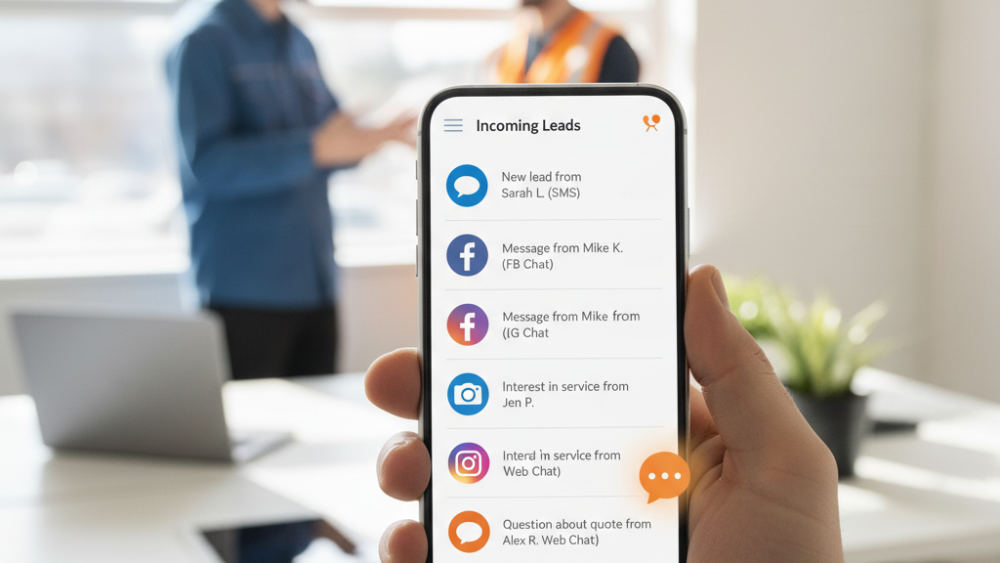
AI automates lead response through specialized agents that monitor every communication channel and engage prospects instantly. Time of day doesn't matter. This eliminates the single biggest conversion killer: slow follow-up that lets prospects contact competitors while they wait to hear from you.
Launch CRM's AI Agent handles phone calls using Voice AI to answer questions, qualify leads, and book appointments directly into your calendar without receptionist overhead. Someone calls after clicking your ad? Voice AI greets them professionally, asks what they need, checks your calendar availability, and confirms their appointment. It's a natural conversation that most callers can't distinguish from speaking with a human assistant.
The 60-second response standard applies across all channels. A lead submits a form, starts a web chat, or messages your Google Business Profile? Conversation AI immediately engages with personalized responses based on the lead source and their specific inquiry. Someone asking about pricing gets one response flow, someone requesting an appointment gets another, and someone with a technical question gets routed appropriately.
Reviews AI handles reputation management by automatically requesting reviews after successful appointments or sales. The system waits for the optimal moment (typically 24-48 hours post-service when satisfaction is highest), then sends personalized review requests via email or SMS. Customers post reviews? Reviews AI responds professionally to both positive and negative feedback, and displays your best testimonials on your website and advertising landing pages to improve conversion rates.
Content AI generates follow-up email and SMS sequences tailored to each lead's behavior. Cold leads who haven't engaged receive educational content building value over 5-7 touchpoints. Warm leads get social proof and urgency messaging over 3-4 touchpoints. Hot prospects receive appointment reminders and direct booking links. The system adjusts content and frequency based on engagement patterns, sending more messages to responsive leads and backing off from those who don't open emails.
Building and Managing Campaigns Inside an All-in-One Platform
Building campaigns inside an all-in-one platform starts with creating a landing page using Funnel AI. The drag-and-drop builder includes proven templates for lead generation, appointment booking, product sales, and webinar registration. You add your headline, benefits, images, and conversion form, then connect it to your booking calendar or email sequence.
Next, set up email and SMS workflows that automatically nurture every lead. Someone fills out your form but doesn't book immediately? They enter a 7-day sequence: welcome email within 60 seconds, educational content on day 2, case study on day 4, limited-time offer on day 6. The workflow pauses if they book an appointment and resumes if they cancel, adapting to behavior without manual oversight.
Track performance through the reporting dashboard, which shows leads by source, conversion rates by channel, revenue by campaign, and cost per acquisition across all advertising programs in one view. You see exactly which Google Ads keywords, Facebook audiences, and email campaigns produce paying customers (not just clicks or impressions). This visibility lets you double down on what works and cut what doesn't within days rather than months.
Workflow AI eliminates manual tasks by triggering actions based on lead behavior. Someone opens three emails but doesn't book? The system automatically assigns them to a sales rep for personal outreach or adds them to a different ad retargeting audience. A customer completes a purchase? Workflows request a review, offer a referral incentive, and add them to your VIP email list. All without touching your to-do list.
| Feature | Multi-Tool Setup | Marketing Automation Platform | All-in-One Business Platform |
|---|---|---|---|
| Lead capture tools | Separate form software | Built-in forms and landing pages | Forms, chat, GMB messaging, missed call text back |
| Response speed | Manual or delayed integration | Email automation only | Multi-channel AI response under 60 seconds |
| Channel coverage | One or two channels | Email and social media | Email, SMS, voice, chat, social DMs |
| Learning curve | 5-8 different interfaces | One platform, steep learning | One platform, intuitive setup |
| Average monthly cost | $500-$2,000 | $300-$800 | $200-$400 |
Additional tools like memberships turn one-time buyers into recurring customers. Quizzes qualify leads before they reach sales reps. Webinars educate prospects at scale. Communities create peer-to-peer support, reducing service costs. The affiliate manager turns satisfied customers into brand advocates who generate qualified referrals. Every tool shares the same customer database, so you see the complete relationship history without switching systems.
For businesses looking to systematically strengthen their market position, Brand Revitalization courses teach how to develop brand strategy, harness core purpose, keep messaging fresh, and ensure customer loyalty. Combined with strong advertising execution, these strategic foundations determine whether campaigns produce short-term leads or long-term business growth.
Common Mistakes and When Not to Use Automated Programs
The most damaging mistake is launching advertising campaigns before setting up automated response systems. Every hour of delay reduces conversion probability by 50-70%, meaning you waste half to three-quarters of your ad budget when leads sit uncontacted. Set up your lead capture and follow-up infrastructure before spending on ads.
Another common error is prioritizing ad spend over conversion infrastructure. Businesses often invest $2,000-$5,000 monthly driving traffic while using free or cheap CRM tools that lose 60% of leads to slow follow-up. You generate better results spending $1,500 on ads paired with $300 on proper automation than $4,000 on ads feeding into a broken response system.
Fully automated programs work poorly for complex B2B sales requiring detailed technical explanation or custom quotes. These situations need AI for initial response and qualification (answering basic questions, collecting requirements, checking budget), then immediate human handoff for the consultative conversation that closes deals. Pure automation frustrates prospects who need expert guidance, while pure manual follow-up wastes time on unqualified leads.
Privacy regulations impact online advertising programs by limiting third-party tracking cookies and requiring explicit consent for email and SMS marketing. GDPR and CCPA make it harder to retarget website visitors and track users across sites, increasing the value of first-party data collection through direct conversations. Platforms that capture leads through multiple first-party channels like web chat, phone calls, and form submissions perform better in this environment than those relying solely on cookie-based retargeting.
Online advertising programs alone do not solve poor product-market fit or ineffective offers. Your ads generate leads but no one buys after speaking with you? The issue is positioning, pricing, or product quality rather than automation. Fix your core offer before optimizing your funnel, otherwise you'll just follow up efficiently on prospects who'll never convert.
Watch out. Launching advertising campaigns without automated response systems wastes 50-70% of your ad budget. Set up your lead capture and follow-up infrastructure before spending on ads.
Businesses with fewer than 20 leads per month may not need sophisticated automation. Simple email follow-up and personal outreach suffice until volume justifies platform investment. Once you cross 20-30 leads monthly, manual processes break down and automation becomes cost-effective.
Choosing the Right Program and Taking Action
Evaluate platforms based on five criteria. Lead response speed matters most because every minute of delay kills conversions. Number of tools consolidated determines your cost savings and operational complexity. Ease of use affects whether you'll actually leverage the features or just pay for unused capabilities. Reporting clarity shows whether you can make data-driven budget decisions. Total monthly cost includes both advertising spend and tool subscriptions.
Request demos from two to three platforms to see actual lead flow, automation setup, and reporting dashboards in action. Watch how leads move from ad click to first response to booked appointment, and time how many seconds each step takes. Ask to see the unified reporting view that shows ROI by channel, because many platforms promise integration but still require manual data consolidation.
Calculate your current total cost by adding up every tool subscription: CRM, email platform, SMS service, scheduling software, funnel builder, webinar platform, review management, contracts and invoicing, plus social media management. Most businesses discover they're spending $500-$2,000 monthly across fragmented systems while spending hours each week moving data between them. Consolidation saves both money and time while improving results through better data unity.
Prioritize platforms offering comprehensive reputation and review management as part of their all-in-one business management tools. Positive reviews improve advertising conversion rates by 15-30% because prospects trust peer feedback more than marketing claims. Automating review collection and display turns satisfied customers into your most effective advertising channel.
For businesses ready to consolidate their advertising, CRM, and marketing automation into one AI-powered platform, Launch CRM replaces multiple tools, improves lead response to under 60 seconds, and increases conversion rates by 30-50%. See the complete feature set and understand how the AI-powered platform works before making your decision.
Frequently asked questions
What are the essential components of a successful online advertising strategy?
A successful strategy combines targeted ad campaigns on 2-3 relevant channels, landing pages optimized for mobile conversion, automated lead capture through forms and chat, immediate response systems that contact leads within 60 seconds, nurture sequences via email and SMS, and unified analytics tracking ROI by channel. The advertising channel matters less than response speed and follow-up consistency. Most businesses lose more revenue to slow lead response than to poor ad targeting.
How can businesses measure the effectiveness of their online advertising programs?
Track four key metrics: cost per lead by channel, lead-to-appointment conversion rate, appointment-to-sale conversion rate, and customer lifetime value by acquisition source. Integrated platforms provide a single dashboard showing these metrics across all channels, while disconnected tools require manual data consolidation that often misses 20-30% of attribution. The most effective measurement approach connects advertising spend directly to closed revenue (not just clicks or form submissions).
What is the role of automation in managing multiple online advertising campaigns?
Automation handles three critical functions: immediate lead response across all channels regardless of time of day, consistent follow-up sequences that nurture leads through 5-10 touchpoints, and dynamic budget allocation that shifts spending toward channels producing the highest ROI. AI-powered automation platforms monitor campaign performance continuously and adjust bids, audiences, and creative in real time, eliminating the need for daily manual optimization. The greatest ROI from automation comes from faster lead response. Automated systems that engage leads within 60 seconds convert 40-60% more leads than manual follow-up.
How do privacy regulations impact online advertising programs?
Regulations like GDPR and CCPA limit third-party tracking cookies and require explicit consent for email and SMS marketing, making it harder to retarget website visitors and track users across sites. These changes increase the value of first-party data collection through direct conversations via web chat, phone calls, and form submissions where users voluntarily provide contact information. Platforms that capture leads through multiple first-party channels perform better in a privacy-restricted environment than those relying solely on cookie-based retargeting.
What trends are shaping the future of online advertising?
AI-driven automation is the dominant trend, with platforms increasingly handling ad creation, audience targeting, bid optimization, and lead qualification without human intervention. Conversational marketing through AI agents that respond via chat, SMS, and voice is replacing traditional form-based lead capture. The shift from multi-tool marketing stacks to all-in-one platforms is accelerating as businesses prioritize speed and data unity over specialized point solutions that require manual integration.
What are the common pitfalls to avoid when implementing online advertising programs?
The most common mistake is launching ads before setting up automated response and follow-up systems, resulting in 50-70% of leads never receiving contact. Many businesses split their budget across too many channels without sufficient spend in any single channel to gather meaningful performance data or achieve platform algorithm optimization. Another pitfall is measuring success by clicks or impressions rather than tracking the complete funnel from ad click through lead response to closed sale, missing the insight that some low-click channels produce higher-value customers.
How can I manage all my business tools in one platform?
An all-in-one platform combines CRM, email marketing, SMS marketing, sales funnels, appointment scheduling, web chat, GMB messaging, social media DM management, workflows, webinars, invoicing, contracts, and reporting into a single login. Launch CRM consolidates 5-8 separate business tools, eliminating data transfer between systems and reducing monthly subscription costs by $500-$2,000 while improving lead response time. The unified approach means every lead from every advertising channel flows into the same automated response system, ensuring nothing falls through the cracks between disconnected platforms.
Businesses ready to consolidate their advertising and customer management into one AI-powered platform should call 760-253-1477 to see how Launch CRM replaces multiple tools, improves lead response, and increases conversion rates through unified data and automation.