
List of CRM Systems for Lead Management and Sales
Last updated September 25, 2026
A customer relationship management system is a platform that helps businesses manage and analyze customer interactions and data throughout the customer lifecycle. This list of CRM systems examines platforms transforming how companies handle leads, automate follow-up, and drive revenue. With an estimated 91% of businesses with over 10 employees now using CRM systems, selecting the right platform has become critical for competitive advantage.
Table of contents
- Popular CRM Systems Comparison
- Launch CRM replaces multiple business tools with a single AI-powered platform that responds to leads in under 60 seconds
- HubSpot CRM excels at categorizing buyers and automating sales processes
- Creatio offers an AI-native CRM and workflow platform with specialized agents
- Salesforce remains a leading cloud-based CRM platform for enterprise deployments
- Microsoft Dynamics 365 integrates CRM with ERP for a holistic customer view
- Pipedrive specializes in visual sales pipeline management for deal tracking
- Zoho CRM specializes in lead and contact management with automation
- Sugar CRM improves agent productivity with flexible deployment options
- Additional CRM examples worth considering
- Sales-focused CRM platforms for closing deals faster
- How to choose the right CRM platform for your needs
- Key features in modern CRM software
- Measuring CRM success and return on investment
- Frequently asked questions
Popular CRM Systems Comparison
| CRM Platform | Best For | Key Strength | Starting Price |
|---|---|---|---|
| Launch CRM | All-in-one AI automation | Sub-60-second lead response | Contact for pricing |
| HubSpot | Inbound marketing | Free tier with upgrades | Free to Enterprise |
| Salesforce | Enterprise scale | Extensive integrations | Custom pricing |
| Pipedrive | Visual pipeline management | Deal tracking focus | Mid-tier pricing |
| Zoho CRM | Customization | Workflow automation | Budget-friendly |
| Microsoft Dynamics 365 | ERP integration | Holistic customer view | Module-based pricing |
Launch CRM replaces multiple business tools with a single AI-powered platform that responds to leads in under 60 seconds
Launch CRM consolidates CRM, marketing, sales automation, and customer service into one login. You can eliminate separate subscriptions to chat tools, email platforms, scheduling software, and review management systems. The platform's AI Agent (Rocket) answers incoming leads in under 60 seconds, handles phone calls, books appointments, and posts reviews automatically.
Six specialized AI teammates (Conversation AI, Voice AI, Reviews AI, Content AI, Funnel AI, Workflow AI) work around the clock to manage web chat, missed call text back, GMB messaging, forms, surveys, webinars, social media DMs, workflows, email marketing, sales funnels, SMS marketing, pipelines, invoicing, contracts, text-to-pay, and booking calendars. This consolidation typically replaces 5–12 separate subscriptions, reducing training overhead and eliminating data silos between marketing, sales, and service teams.
Reporting dashboards, affiliate management, communities, and reputation management features provide complete visibility into lead response performance and customer sentiment from a single interface.
HubSpot CRM excels at categorizing buyers and automating sales processes
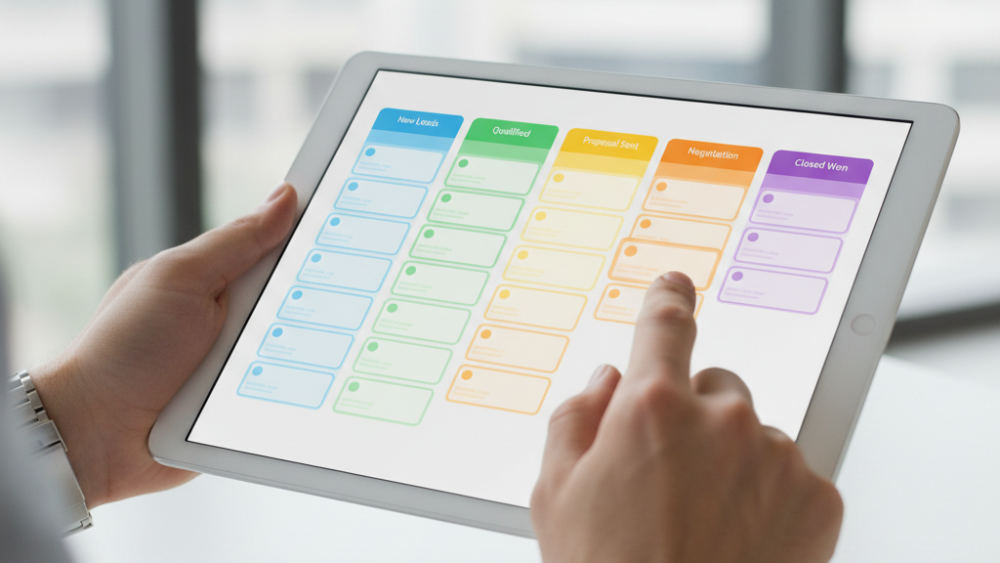
HubSpot is a CRM system known for its inbound marketing, sales, service, and content management tools, including AI for buyer categorization. The platform organizes customers into specific categories based on their expectations, allowing sales and marketing teams to focus on prospective buyers most likely to convert. Its AI model automates quote creation, invoicing, approvals, and buyer insights, reducing manual data entry and accelerating deal closure.
A built-in prospecting agent detects buying signals across customer interactions and recommends contacts for outreach. An AI-powered customer agent handles incoming calls, and companies can customize its responses to match their brand voice. HubSpot's strength lies in its inbound marketing foundation, which aligns naturally with businesses that generate leads through content, SEO, and social media.
The free tier offers basic contact management, making it accessible for companies testing their first CRM deployment. Companies already invested in HubSpot's ecosystem benefit from seamless integration between its Marketing Hub, Sales Hub, Service Hub, and CMS.
Source: getvoip.com
Creatio offers an AI-native CRM and workflow platform with specialized agents
Creatio offers an AI-native CRM and workflow platform with no-code capabilities and specialized AI agents for sales and marketing. The platform features a no-code builder, allowing users to create applications with AI coding agents and visual designers without extensive coding knowledge. Sales AI agents include lead scoring, deal insights, and forecasting to optimize the sales cycle and predict which opportunities deserve immediate attention.
Marketing AI agents provide customer segmentation and predictive analytics for personalized campaigns that adapt to behavioral patterns. Creatio invested $300 million in its Bank.ai platform to drive AI adoption in financial services, demonstrating enterprise-grade commitment to vertical specialization. BSN Sports achieved 60% growth in sales book size using Creatio's no-code platform to streamline processes and adapt rapidly to market changes.
The CRM market was valued at 57.7 billion dollars in 2022 and is projected to grow to 128.9 billion by 2028, with platforms combining AI capabilities with workflow automation capturing increasing market share.
Source: creatio.com
Salesforce remains a leading cloud-based CRM platform for enterprise deployments
Salesforce is a leading cloud-based CRM platform known for its comprehensive sales, service, and marketing solutions. The system provides tools for lead management, sales automation, and customer service that support businesses from startup to enterprise scale. It offers integration options through its AppExchange, extending functionality with thousands of third-party applications.
The platform is known for its robust reporting and analytics capabilities, helping businesses gain insights into sales performance, pipeline health, and revenue forecasting. Salesforce supports various industries with scalable solutions tailored to verticals including healthcare, financial services, manufacturing, and retail. Its Lightning platform enables custom application development, giving organizations the power to build unique workflows on top of core CRM functionality.
Businesses comparing enterprise options should review analysis of how Salesforce stacks up against all-in-one platforms to understand trade-offs between breadth, cost, and implementation complexity.
Source: getvoip.com
Microsoft Dynamics 365 integrates CRM with ERP for a holistic customer view
Microsoft Dynamics 365 provides a suite of business applications, integrating CRM with ERP functionalities to offer a holistic customer view. The platform delivers tools for sales, marketing, and customer service, unified within a single system that connects financial and operational data. It tracks leads across the business, offering insights into customer interactions at every touchpoint from initial inquiry through purchase and support.
Dynamics 365 helps make better sales predictions through integrated data and analytics that correlate customer behavior with financial outcomes. The platform is available as a proprietary or SaaS solution, with deployment options including Windows and MS SQL backend for organizations with specific infrastructure requirements. Its tight integration with Microsoft's ecosystem (Office 365, Teams, Power BI, and Outlook) creates natural workflow efficiencies for businesses already standardized on Microsoft tools.
The modular pricing structure allows businesses to purchase only the apps they need, though unlocking full value typically requires multiple modules.
Source: getvoip.com
Pipedrive specializes in visual sales pipeline management for deal tracking
Pipedrive is a sales-focused CRM system emphasizing visual sales pipeline management to improve deal tracking and follow-up. The platform focuses on actionable sales processes, shifting the emphasis from static data storage to controllable actions that move deals forward. Its visual pipeline allows users to easily see the status of deals and identify those that have been idle too long, triggering timely follow-up.
Pipedrive offers features like lead management, sales automation, email sync, and tracking that reduce manual pipeline maintenance. The platform aims to prevent leaking pipelines by providing clear cues and helping manage the sales engine efficiently, reducing revenue loss from neglected opportunities. The interface is intuitive for sales representatives who need to update deal stages quickly without navigating complex menus or fields.
Teams needing consolidated email marketing, SMS campaigns, and review management alongside their CRM may find themselves managing multiple platforms despite Pipedrive's strengths in deal tracking.
Source: pipedrive.com
Zoho CRM specializes in lead and contact management with automation
Zoho CRM specializes in lead and contact management, offering extensive automation and customization features. The system helps manage leads and contacts through various stages, from initial engagement to conversion, with customizable workflows for each funnel stage. It provides tools for workflow automation, allowing businesses to set up automated actions based on specific triggers such as lead score changes or form submissions.
Zoho CRM is highly customizable, enabling businesses to tailor the platform to their unique needs and processes without relying on external developers. The platform supports email marketing, analytics, and integrates with other Zoho applications for a comprehensive business suite spanning finance, projects, and HR. Companies already using Zoho Books, Zoho Projects, or other Zoho tools benefit from pre-built integrations and unified reporting across business functions.
The pricing is competitive, particularly for small businesses balancing feature needs against budget constraints. Navigating the full Zoho ecosystem requires understanding which of the dozens of applications fits each use case.
Source: getvoip.com
Sugar CRM improves agent productivity with flexible deployment options
Sugar CRM focuses on improving agent productivity and offers flexible deployment options for managing customer relationships. The platform provides tools designed to enhance how sales and support teams work with customer data, emphasizing efficiency and actionable insights. Sugar CRM delivers both cloud-based and on-premises deployment models, giving organizations control over where customer data resides and how it integrates with existing infrastructure.
The system includes features for sales automation, marketing campaigns, and customer support that help teams collaborate across departments. Sugar CRM's open architecture allows for extensive customization and integration with third-party applications, making it adaptable to specialized industry requirements.
"Sugar CRM's flexible deployment and customization options make it valuable for organizations with specific data governance or integration needs."
Additional CRM examples worth considering
Freshworks provides CRM solutions that leverage Artificial Intelligence to optimize customer support and sales processes. The platform utilizes AI to automate routine tasks and provide intelligent insights for sales and customer service teams, reducing time spent on manual data entry. Its CRM includes features for lead management, deal tracking, and communication tools that consolidate email, phone, and chat interactions.
Agile CRM integrates sales, marketing, and customer support to enhance the overall customer experience. The platform combines contact management, deal tracking, email campaigns, and helpdesk features in a single interface designed for small and midsize businesses. Agile CRM aims to provide enterprise-level functionality at accessible price points for growing companies.
Keap (formerly Infusionsoft) offers CRM combined with marketing automation and sales tools, primarily targeting small businesses for process automation. The system integrates CRM functionalities with email marketing, landing page creation, and e-commerce features that support the entire customer acquisition funnel. The drag-and-drop campaign builder allows non-technical users to design sophisticated multi-step sequences that move leads from cold prospect to paying customer.
Source: getvoip.com
Sales-focused CRM platforms for closing deals faster
Zendesk Sell (formerly Base CRM) is a CRM focused on sales and outreach, designed to make communication and lead management effortless. The platform offers features designed to streamline sales outreach and communication with prospects, reducing friction in the contact process. It supports iOS and Android devices, allowing sales professionals to manage their activities on the go and respond to leads from any location.
The system integrates with various communication channels to unify all customer interactions, preventing information silos between desk and field teams. The mobile app delivers full functionality rather than a stripped-down version, enabling field representatives to log calls, update deal stages, and access contact history without returning to the office. Zendesk Sell targets sales organizations seeking tight integration with Zendesk Support, creating a unified view of customer relationships from first contact through ongoing service.
Close CRM is designed for sales teams, providing multiple pipeline views and integrated communication tools to close deals efficiently. The platform emphasizes built-in calling, SMS, and email capabilities that eliminate the need to switch between applications during prospect conversations. Close CRM focuses on inside sales teams that make high volumes of outbound contacts and need streamlined workflows to maximize talk time.
Act! CRM is a long-standing customer relationship management system offering contact management and sales features. The platform has served small and midsize businesses for decades with desktop and cloud deployment options. Act! CRM provides traditional contact database functionality, calendar management, and opportunity tracking for organizations preferring straightforward tools without extensive automation or AI features.
Source: en.wikipedia.org
How to choose the right CRM platform for your needs
Evaluate your current tool stack and identify which functions you need consolidated. CRM software can include far-reaching tools with multiple purposes that enable companies to nurture customer relationships and increase sales. Prioritize lead response speed by testing how each platform handles inbound inquiries (78% of customers buy from the company that responds first). Verify integration capabilities with your existing tools, especially accounting software, e-commerce platforms, and communication channels you already use.
Calculate total cost of ownership including setup, training, monthly fees, and any per-user or per-feature charges that emerge after the base subscription. Request a trial period long enough to test automation workflows, AI features, and reporting dashboards with real customer data before committing. Compare how each platform addresses your specific pain points rather than chasing feature counts that look impressive on paper but never get used.
Consider whether you need industry-specific functionality or whether a general platform with strong customization serves your business model better. Examine mobile access carefully if your team works in the field or needs real-time updates outside traditional office hours. Review customer support options and community resources, since even intuitive platforms require assistance during implementation and optimization phases.
For businesses exploring advanced automation, Launch Commerce offers complementary webinar and marketing tools that extend CRM capabilities across the customer journey.
Source: getvoip.com
Key features in modern CRM software
Lead capture and distribution ensure incoming inquiries reach the right team member immediately, reducing response time and preventing leads from falling through cracks. Contact management centralizes customer information, interaction history, and communication preferences in searchable profiles accessible across departments. Pipeline visualization displays deals at each stage, highlighting opportunities requiring attention and forecasting revenue based on stage conversion rates.
Automation workflows trigger actions based on customer behavior, time delays, or data changes, eliminating repetitive manual tasks and ensuring consistent follow-up. Email and SMS marketing tools segment audiences, personalize messages, and track engagement without requiring separate platforms. Reporting and analytics measure performance metrics, identify bottlenecks, and quantify ROI across marketing campaigns, sales activities, and service interactions.
Mobile access allows field teams to log activities, access customer data, and update records from any location, keeping information current regardless of where work happens. Integration capabilities connect the CRM to existing business tools, synchronizing data across accounting, e-commerce, communication, and productivity platforms. AI features include predictive lead scoring, conversation automation, intelligent routing, and next-best-action recommendations that augment human decision-making.
Measuring CRM success and return on investment
Track lead response time as your primary speed-to-lead metric, aiming for under 5 minutes for inbound inquiries and measuring improvement month over month. Monitor conversion rates at each pipeline stage to identify bottlenecks. If opportunities stall between demo and proposal, your CRM should flag those deals for intervention. Calculate cost per acquisition before and after CRM implementation to quantify the financial impact of automation and better lead prioritization.
Measure user adoption through login frequency, data entry completeness, and workflow utilization (low engagement signals training gaps or poor platform fit). Review customer lifetime value trends to assess whether improved relationship management translates into repeat business and referrals. Compare sales cycle length before and after deployment to determine whether your CRM accelerates deal velocity as promised.
Track the number of tools replaced by your CRM platform and calculate monthly subscription savings, factoring in reduced training overhead and eliminated data silos. Monitor customer satisfaction scores and service response times to evaluate whether centralized interaction history improves support quality. Analyze revenue per sales representative to determine whether automation and AI features allow each team member to manage larger pipelines without sacrificing close rates.
Frequently asked questions

What is a list of CRM systems available in 2026?
A comprehensive list of CRM systems includes Launch CRM for all-in-one AI automation, HubSpot for inbound marketing, Salesforce for enterprise scale, Pipedrive for visual pipeline management, Zoho CRM for customization, Microsoft Dynamics 365 for ERP integration, Creatio for no-code workflows, Freshworks for AI-driven support, Keap for small business automation, Zendesk Sell for sales outreach, Close CRM for inside sales teams, Sugar CRM for agent productivity, Act! CRM for traditional contact management, and Agile CRM for integrated sales and marketing.
What are the best CRM tools for lead management?
The best CRM tools for lead management prioritize rapid response, automation, and pipeline visibility. Launch CRM responds to leads in under 60 seconds with AI agents handling calls, chats, and follow-ups automatically. HubSpot excels at inbound lead nurturing with automated workflows and buyer categorization. Pipedrive provides visual deal tracking to prevent opportunities from stalling. Selection depends on whether you prioritize speed, marketing integration, or sales focus.
How does a list of CRM platforms differ from a list of CRM software?
A list of CRM platforms and a list of CRM software refer to the same category of business tools. The terms are used interchangeably to describe systems that manage customer relationships, track interactions, and automate sales and marketing processes. Some sources use "platform" to emphasize extensibility and integrations, while "software" highlights the application itself, but both describe CRM systems.
What CRM examples demonstrate AI automation?
CRM examples with AI automation include Launch CRM's Voice AI handling phone calls and Conversation AI managing chat across channels, HubSpot's prospecting agent detecting buying signals, Creatio's AI agents for lead scoring and deal insights, and Freshworks' intelligent task automation. These systems use artificial intelligence to reduce manual work, predict outcomes, and respond to customers without human intervention.
How can I compare CRM systems effectively?
A CRM systems comparison should evaluate lead response speed, automation capabilities, integration options, mobile access, pricing structure, and total cost of ownership. Test each platform with real customer data during trial periods. Compare how many business tools each CRM replaces (consolidated platforms deliver better ROI than systems requiring multiple integrations). Measure against your specific pain points rather than generic feature lists. Resources like Wikipedia: Comparison of CRM systems provide technical specifications, while vendor sites like Creatio and Pipedrive offer detailed feature breakdowns.
Are there free CRM solutions suitable for small businesses?
HubSpot offers a free CRM tier with basic contact management and email tracking, suitable for startups testing CRM adoption. Free plans typically lack automation, AI features, and advanced reporting that drive ROI for growing businesses. Launch CRM provides comprehensive tools in paid plans designed to replace multiple business subscriptions, delivering net savings despite the monthly fee. Evaluate whether free limitations will force a migration as your business scales.
What is the difference between CRM software and marketing automation?
CRM software manages customer relationships, tracks interactions, and supports sales processes across the entire customer lifecycle. Marketing automation focuses specifically on campaign execution, lead nurturing, and prospect engagement before sales handoff. Many modern CRM platforms include marketing automation as a built-in feature, eliminating the need for separate tools. All-in-one systems like Launch CRM combine both functions with sales, service, and operations in a single platform.
How does Launch CRM consolidate business tools?
Launch CRM consolidates CRM, marketing automation, sales funnels, email and SMS campaigns, web chat, GMB messaging, forms, surveys, webinars, social media DMs, invoicing, contracts, text-to-pay, booking calendars, and reputation management into a single login. This approach replaces 5 to 12 separate subscriptions with one platform, reducing training overhead and eliminating data silos. The AI Employee Suite provides six specialized teammates working around the clock across these consolidated functions.
Ready to transform how your business captures, nurtures, and converts leads? Discover how Launch CRM's all-in-one AI platform can replace your scattered tools and put AI to work for your team around the clock, or call 760-253-1477 to speak with a specialist.